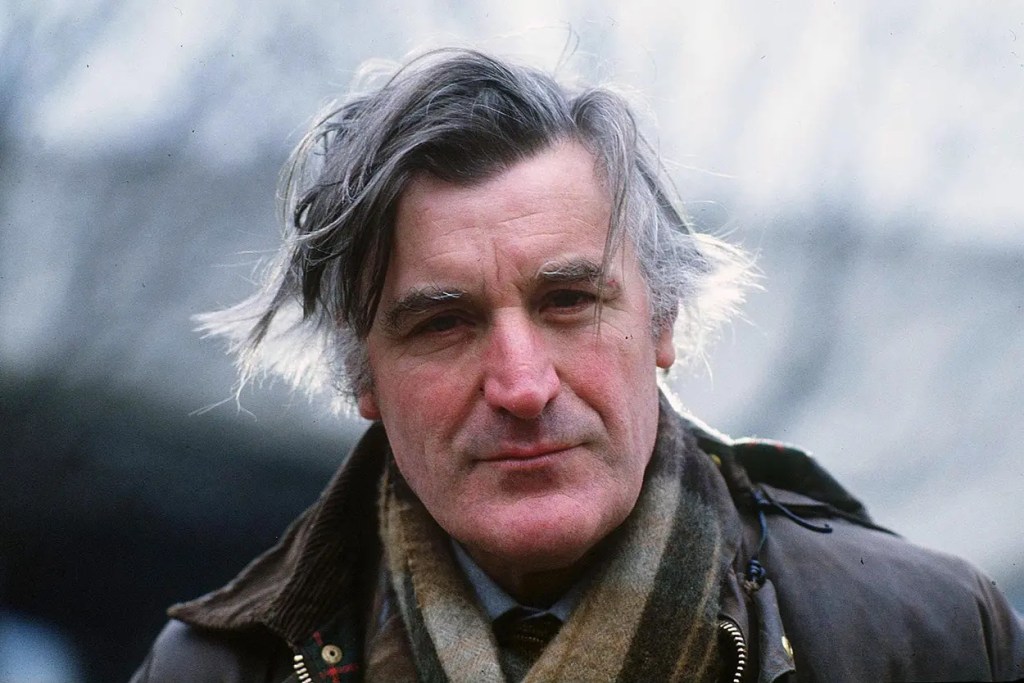
“Metamorphoses” is the most famous work of Ovid (43 BCE-17 or 18), one of the greatest of Roman poets, and has huge cultural importance, inspiring poets, painters, and other artists. A translation into English by Arthur Golding in 1567 was an inspiration and source for Shakespeare. I have a copy of Golding’s translation, but it’s much longer and a much tougher read than Ted Hughes’s (1930-1998) version of some of the poems, which is a favourite book of mine. Hughes’s version is not a translation, but the poems sparkle with life, humour, stories, and images—and are easily read. The one below tells the story of Tiresias, a man who was transformed into a woman after killing two copulating snakes. After seven years as a woman, he was transformed back to a man. He was thus in a unique position to answer the question of Jupiter “In their act of love/Who takes the greater pleasure, man or woman?’ Ovid was exiled from Rome, and I have seen his statue in the middle of a dreary housing estate in Constantia, Romania. Hughes is notorious for making love to another woman while Silvia Plath, his poet wife, killed herself with her two young children in the next room.
Tiresias
One time, Jupiter, happy to be idle,
Swept the cosmic mystery aside
And draining another goblet of ambrosia
Teased Juno, who drowsed in bliss beside him:
‘This love of male and female’s a strange business.
Fifty-fifty investment in the madness,
Yet she ends up with nine-tenths of the pleasure.’
Juno’s answer was: ‘A man might think so.
It needs more than a mushroom in your cup
To wake a wisdom that can fathom which
Enjoys the deeper pleasure, man or woman.
It needs the solid knowledge of a soul
Who having lived and loved in woman’s body
Has also lived and loved in the body of a man.’
Jupiter laughed aloud: ‘We have the answer.
There is a fellow called Tiresias.
Strolling to watch the birds and hear the bees
He came across two serpents copulating.
He took the opportunity to kill
Both with a single blow, but merely hurt them –
And found himself transformed into a woman.
‘After the seventh year of womanhood,
Strolling to ponder on what women ponder
She saw in that same place the same two serpents
Knotted as before in copulation.
“If your pain can still change your attacker
Just as you once changed me, then change me back.”
She hit the couple with a handy stick,
‘And there he stood as male as any man.’
‘He’ll explain,’ cried Juno, ‘why you are
Slave to your irresistible addiction
While the poor nymphs you force to share it with you
Do all they can to shun it.’ Jupiter
Asked Tiresias: ‘In their act of love
Who takes the greater pleasure, man or woman?’
‘Woman,’ replied Tiresias, ‘takes nine-tenths.’
Juno was so angry – angrier
Than is easily understandable –
She struck Tiresias and blinded him.
‘You’ve seen your last pretty snake, for ever.’
But Jove consoled him: ‘That same blow,’ he said,
‘Has opened your inner eye, like a nightscope. See:
‘The secrets of the future – they are yours.’
 A Cairn of Poems
Leave a comment