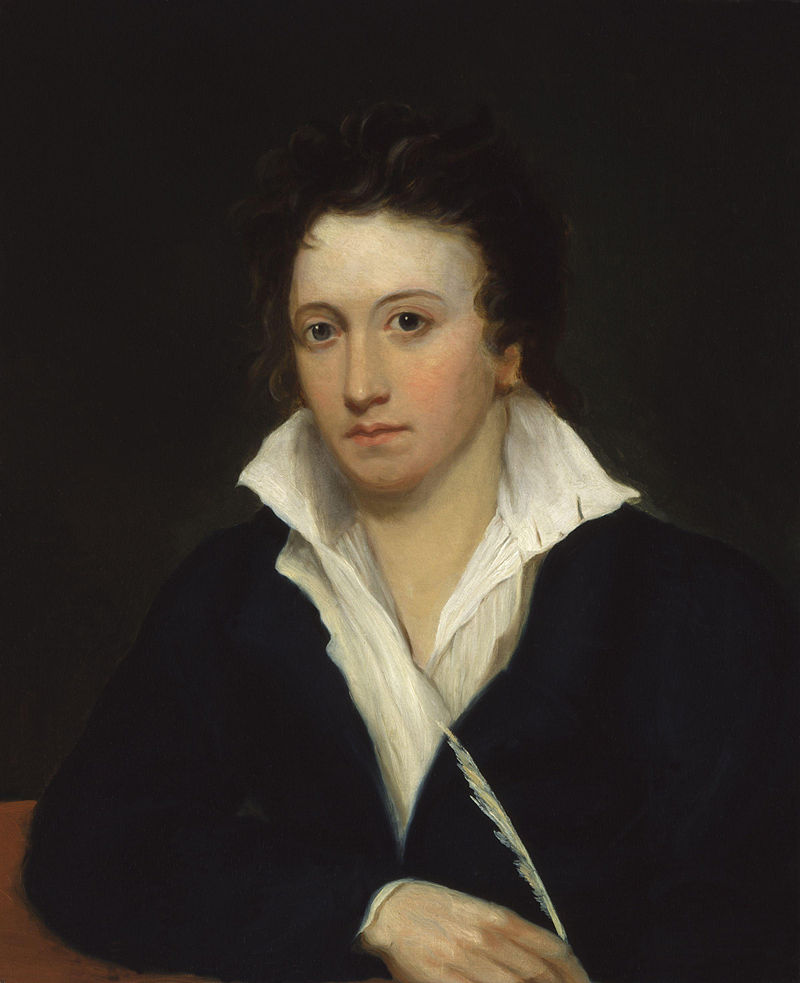
Percy Bysshe Shelley (1792-1822) is one of the bad boys of English poetry, promoting atheism and radicalism, abandoning his pregnant teenage wife, enjoying being loathed by the press and establishment, and drowning at sea before his 30th birthday after sailing in a storm. But his friends found him gentle, urbane, and lovable, and after he died his friend, Byron, said that everybody he knew was a beast in comparison with Shelley. Carlyle, T S Eliot, and W H Auden thought him a bad poet, decrying his adolescence lack of craftmanship, but he was a central influence on great poets like Swinburne, Yeats, and Hardy. I’m intoxicated by his poetry. In her marvellous biography of D H Lawrence Frances Wilson sees Shelley as the English heir to Dante and Lawrence the heir to Shelly. Something that they had in common was that they didn’t see a clear line between poetry and prose.
I’ve not read most of Shelley’s poems but simply the ones that most people read, including Ode to the West Wind, The Triumph of Life, The Mask of Anarchy, and To a Skylark. Lines from those poems reverberate through my mind: Hail to thee, blithe spirit; If winter comes can Spring be far behind; If I were a dead leaf thou mightest bear; If were a swift cloud to fly with thee, A wave to pant beneath thy power, and share they impulse of strength; I feared, loved, hated, suffered, did, and died; We are many they are few (the thought of everybody on a march against injustice).
But the phrase of Shelley’s that is loudest in my mind is “Look on my Works, ye Mighty, and despair.” It comes from Ozymandias, The King of Kings. Whenever I walk among ruins I think of this poem, but I also think of it when I walk through London and other cities: I see them gone and the lone and level sands stretch far away.” Those who want to see the great cities of the world in such a condition may not have long to wait.
Ozymandias
I met a traveller from an antique land,
Who said—“Two vast and trunkless legs of stone
Stand in the desert. . . . Near them, on the sand,
Half sunk a shattered visage lies, whose frown,
And wrinkled lip, and sneer of cold command,
Tell that its sculptor well those passions read
Which yet survive, stamped on these lifeless things,
The hand that mocked them, and the heart that fed;
And on the pedestal, these words appear:
My name is Ozymandias, King of Kings;
Look on my Works, ye Mighty, and despair!
Nothing beside remains. Round the decay
Of that colossal Wreck, boundless and bare
The lone and level sands stretch far away.”
 A Cairn of Poems
Leave a comment