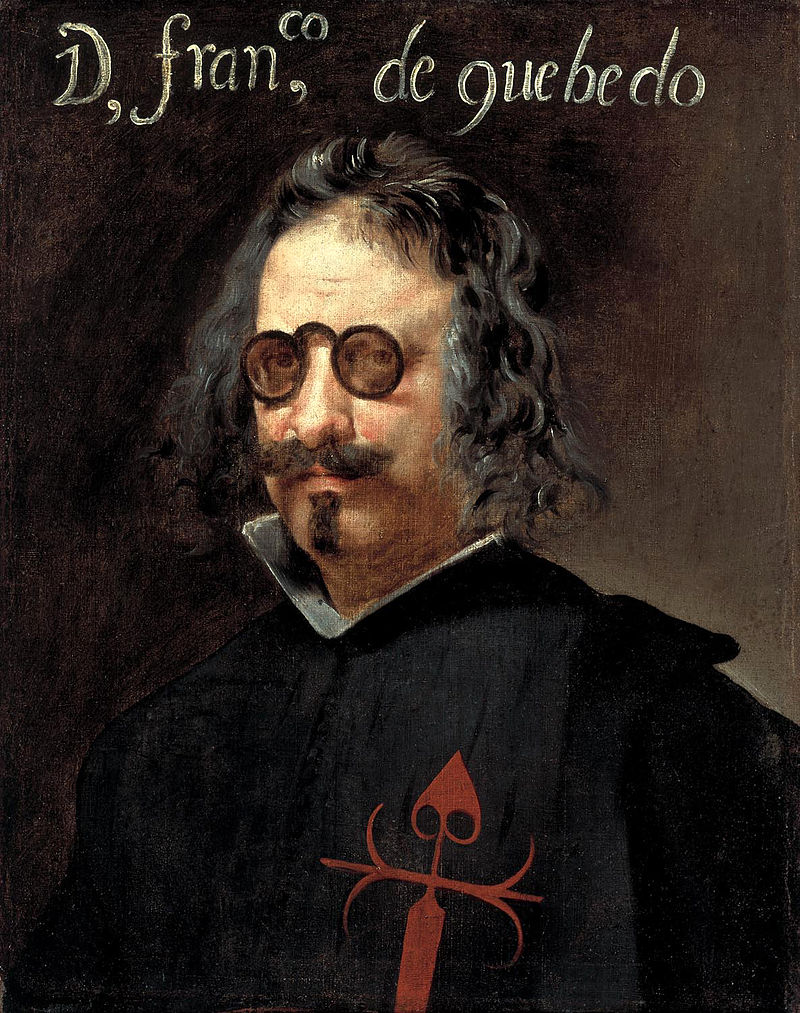
Francisco Gomez de Quevedo (1580-1645) was a Spanish nobleman, politician, and poet. He used the style conceptismo, which has been defined as “a brilliant flash of wit expressed in pithy or epigrammatic style.” Conceptismo uses rapid rhythm, directness, simple vocabulary, witty metaphors, and wordplay. Multiple meanings are conveyed concisely. The style can be philosophical, satirical, and funny.
Translators might have all these thoughts in mind as they translate. I first encountered Amor constante más allá de la muerte (Love Constant Beyond Death) in Poems That Make Grown Men Cry and read the translation by Margaret Jull Costa. But I found two more translations online and share them below. There are so many versions of the poem found so easily on the web because we like the message that it conveys: love will survive death and live in the ash we become. We might think of the ashes that our mother that we scattered somewhere—or perhaps had made into a ring that we wear on our finger. If we have loved many people and many times, will all that love be in our ashes? Of course, I like to think.
The poem no doubt reads best in Spanish, although with some poems there must be examples of where the translated, the derived poem, must be better than the first. All three translations seem acceptable to me. The first does not attempt rhyme while the others do. I read one after the other several times, am struck how different they are, and decide that perhaps I like the second one best. But it’s clear to me that on another day I another mood I might prefer another. I like different lines from the different versions.
From the first, the final lines. I like the use of the word meaning, although it is perhaps too strong.
“The body they will leave, though not its cares;
Ash they will be, but filled with meaning;
Dust they will be, but dust in love.”
From the second version:
“untie the soul from lies
and flattery of death”
And
“My soul, whom a God made his prison of.”
I sometimes think of my body as a prison, I’m locked in here until death.
And I like the ending of the third version:
“They shall be ash. That ash will feel as well.
Dust they shall be. That dust will be in love.”
The ash will not only contain love it will feel.
I think of the last line of Philip Larkin’s poem An Arundel Tomb:
“What will survive of us is love.”
Love Constant Beyond Death by Francisco Gomez de Quevedo Translated by Margaret Jull Costa
Though my eyes be closed by the final
Shadow that sweeps me off on the blank white day
And thus my soul be rendered up
By fawning time to hastening death;
Yet memory will not abandon love
On the shore where first it burned:
My flame can swim through coldest water
And will not bend to laws severe.
Soul that was prison to a god,
Veins that fueled such fire,
Marrow that gloriously burned –
The body they will leave, though not its cares;
Ash they will be, but filled with meaning;
Dust they will be, but dust in love.
Love Constant Beyond Death by Francisco Gomez de Quevedo Translation by Willis Barnstone
The final shadow that will close my eyes
will in its darkness take me from white day
and instantly untie the soul from lies
and flattery of death, and find its way
and yet my soul won’t leave its memory
of love there on the shore where it has burned:
my flame can swim cold water and has learned
to lose respect for laws’ severity.
My soul, whom a God made his prison of,
my veins, which a liquid humour fed to fire,
my marrows, which have gloriously flamed,
will leave their body, never their desire;
they will be ash but ash in feeling framed;
they will be dust but will be dust in love.
Love Constant Beyond Death by Francisco Gomez de Quevedo Translation by A Z Foreman
That terminal shadow may with darkness seal
my eyes shut when it steals white day from me,
and in an instant, flattering the zeal
of this my eager soul, let it go free.
But on this hither shore where once it burned
it shall not leave behind love’s memory.
My flame can swim chill waters. It has learned
to lose respect for laws’ severity.
This soul that was a god’s hot prison cell,
veins that with liquid humors fueled such fire,
marrows that flamed in glory as I strove
shall quit the flesh, but never their desire.
They shall be ash. That ash will feel as well.
Dust they shall be. That dust will be in love.
 A Cairn of Poems
Leave a comment