I find Shakespeare’s sonnets wonderful but tricky. I read them again and again, often out loud, but almost always the full meaning eludes me. Yet there is enough meaning and enough sparkling lines to enchant me
William Shakespeare (1564 –1616) wrote 154 sonnets plus a few more in his plays. All sonnets have 14 lines but a variety of rhyming structures within those 14. Shakespeare’s sonnets follow the Elizabethan rhyme structure of ABAB CDCD EFEF GG. The sonnet developed in Sicily in the 13th century but may have its origins in Arabic poetry. The word sonnet comes from the Italian word sonetto (little song). Sonnets, which are usually love poems, spread across the world and are still written—indeed, Ian McEwan’s latest novel, which I have just read, revolves around a corona, 15 linked sonnets, where the 15th is composed of the first line of the first 14. https://richardswsmith.wordpress.com/2025/12/22/how-to-write-a-readable-and-enjoyable-novel-about-the-climate-crisis-invent-a-new-form/ To write such a poem and not let form overwhelm content must be extremely hard. I have never written a sonnet but should surely try one day.
I particularly like the sonnets of Christina Rossetti and Edna St Vincet Millay.
This sonnet, number 99 in Shakespeare’s sequence, seems to me one of his that is the easiest to follow. Shakespeare accuses various flowers—a violet, a lily, marjoram, and three roses–with stealing attributes from his love. Other flowers that Shakespeare has noted have also stolen from his love, and one rose “nor red, nor white” must pay a price for its theft—“A vengeful canker eat him up to death.”
The sonnet composed of flowers reminded me of the extraordinary paintings of the Italian painter Giuseppe Arcimboldo (1527-1593) who composed portraits from fruits, vegetables, flowers, fish and books.
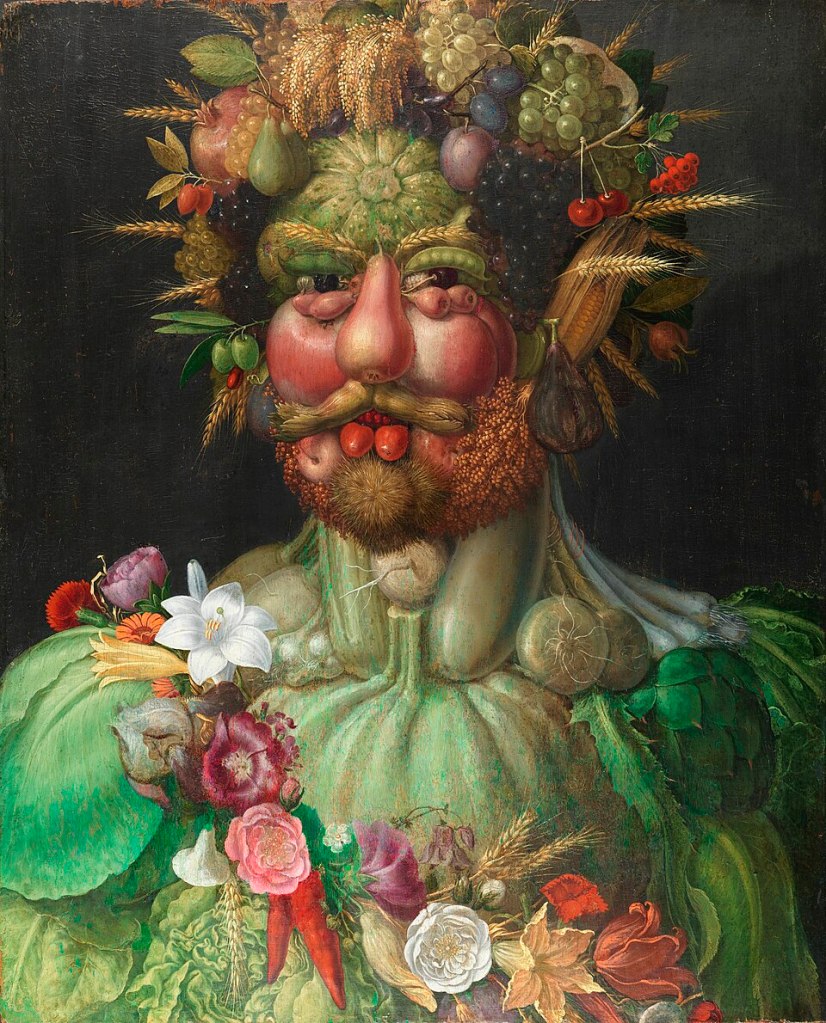
The forward violet thus did I chide by William Shakespeare
The forward violet thus did I chide:
Sweet thief, whence didst thou steal thy sweet that smells,
If not from my love’s breath? The purple pride
Which on thy soft cheek for complexion dwells
In my love’s veins thou hast too grossly dyed.
The lily I condemned for thy hand,
And buds of marjoram had stol’n thy hair:
The roses fearfully on thorns did stand;
A third, nor red nor white, had stol’n of both
And to his robbery had annex’d thy breath;
But, for his theft, in pride of all his growth
A vengeful canker eat him up to death.
More flowers I noted, yet I none could see
But sweet or colour it had stol’n from thee.

 A Cairn of Poems
Leave a comment