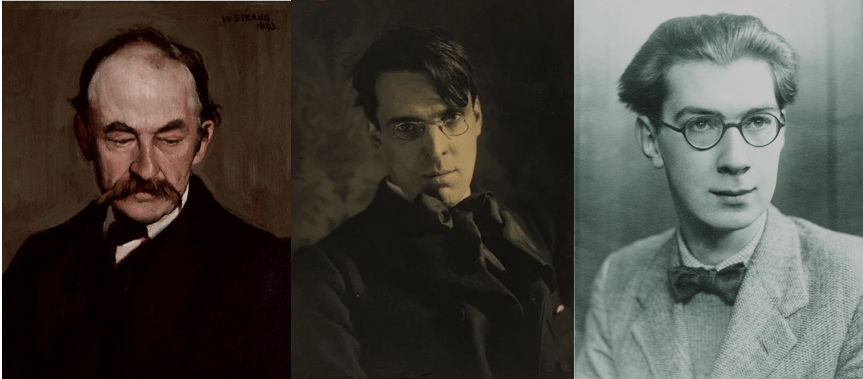
This is a crucial poem in the history of 20th century English poetry. It’s the poem that led Thomas Hardy (1840-1928) to replace W B Yeats (1865-1939) as Philp Larkin’s (1922-1985) prime poetic influence and serve as midwife to Larkin’s wonderful poems. All three poets are at the top of the rankings of 20th century poets and very important to me.
“Nothing else he [Larkin] read influenced him more deeply or more fruitfully,” writes the poet Andrew Motion in Philip Larkin: A Writer’s Life. Larkin wrote: “If I were asked to date its [Celtic fever’s] disappearance, I should guess it was the morning I first read Thoughts of Phena at News of her Death.”
“Instead of Symbolism [in Larkin’s poetry]” writes Motion, “there was fidelity to familiar fact; instead of grand music there was the sound of a fastidious mind thinking aloud; instead of high rhetoric there was modest watchfulness; instead of a longing to transcend there was total immersion in everyday things.”
Larkin said of Hardy: “ What I like about him primarily is his temperament and the way he sees life. He’s not a transcendental writer, he’s not a Yeats, he’s not an Eliot; his subjects are men, the life of men, time and the passing of time, love and the fading of love.”
The Collected Poems of Thomas Hardy is 900 pages long and, as few of his poems are long, must contain some 800 poems. He wrote poems with undiminished power for 60 years, and he wrote on a huge range of subjects, most of them everyday subjects.
When he encountered Hardy, Larkin was miserable and not sleeping well. His relationship with his girlfriend, Ruth Bowman, was foundering, and because of the awful prison of a marriage in which his parents were trapped, he was clear that he would never marry and have children. Bowman wanted both. Perhaps as he read Hardy’s poem, he imagined himself old and reading of the death of Ruth.
Hardy has nothing physical (letters, hair) of Phena, presumably once a lover, and his “unsight” means that he can’t picture her old and dying. What were her final days like? All he has is “a phantom of the maiden of yore,” but that “fined” in his brain to the “more” may be “the best of her.”
Most of us can easily imagine ourselves hearing of the death of a long-lost lover and trying to remember them. I’m sure that there are men who have read of the death of a friend of mine a few weeks ago and are having the same experience that Hardy so beautifully describes.
Thoughts of Phena at the News of Her Death by Thomas Hardy
Not a line of her writing have I
Not a thread of her hair,
No mark of her late time as dame in her dwelling, whereby
I may picture her there;
And in vain do I urge my unsight
To conceive my lost prize
At her close, whom I knew when her dreams were upbrimming with light
And with laughter her eyes.
What scenes spread around her last days,
Sad, shining, or dim?
Did her gifts and compassions enray and enarch her sweet ways
With an aureate nimb?
Or did life-light decline from her years,
And mischances control
Her full day-star; unease, or regret, or forebodings, or fears
Disennoble her soul?
Thus I do but the phantom retain
Of the maiden of yore
As my relic; yet haply the best of her—fined in my brain
It may be the more
That no line of her writing have I,
Nor a thread of her hair,
No mark of her late time as dame in her dwelling, whereby
I may picture her there.
 A Cairn of Poems
Leave a comment