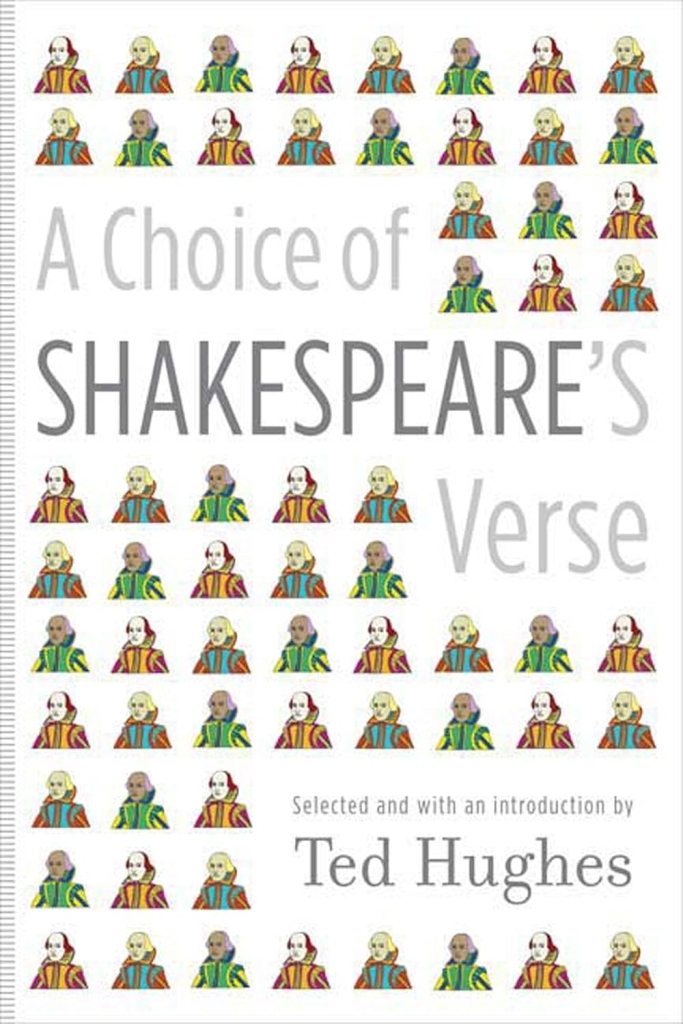
Shakespeare’s nearly 40 plays are stuffed with magnificent poetry, and thanks goodness that Ted Hughes took the trouble to hack out from the plays individual poems that are as good as (and mostly better than) anything written in English specifically as a poem. A Choice of Shakespeares’s Verse also includes many of his sonnets, which although wonderful often demand much more unravelling than the more direct poems of the plays, which must be understood quickly by the theatregoer to move the drama forwards.
I’m reading my way though Hughes’s book, and these two poems, one on love and one on death, come close together in the book. Love (mostly erotic love and always mingled with sex) and death are the two great themes of poetry—and, come to that, art and life; well, maybe less in life, where there is much else to do apart from make love and die—but always these uniquely powerful forces hover.
The the love poem, from Love’s Labour’s Lost, speaks of the power of love that “gives to every power a double power” and allows the lover to “gaze an eagle blind” and “hear the lowest sound.” All who have been in love know these remarkable powers, and in this poem there is no mention of madness or the fevered brain that leads many astray. Why, the poem asks, waste your time on “other slow arts” like medicine or politics, especially when love is easily learnt “in a lady’s eyes.” No need to study for years.
Love gives to every power a double power
Others slow arts entirely keep the brain,
And therefore, finding the barren practisers,
Scarce show a harvest of their heavy toil;
But love, first learnèd in a lady’s eyes,
Lives not alone immurèd in the brain,
But, with the motion of all elements,
Courses as swift as thought in every power,
And gives to every power a double power,
Above their functions and their offices.
It adds a precious seeing to the eye:
A lover’s eyes will gaze an eagle blind.
A lover’s ear will hear the lowest sound,
When the suspicious head of theft is stopped.
Love’s feeling is more soft and sensible
Than are the tender horns of cockled snails.
Love’s tongue proves dainty Bacchus gross in taste.
For valor, is not Love a Hercules,
Still climbing trees in the Hesperides?
Subtle as Sphinx; as sweet and musical
As bright Apollo’s lute, strung with his hair.
And when Love speaks, the voice of all the gods
Make heaven drowsy with the harmony.
I love the first line and a half of this poem from Measure to Measure: “Be absolute for death. Either death or life/Shall thereby be the sweeter.” Thinking of, studying death makes life sweeter and death easier.
You “labor’st by thy flight to shun,/And yet runn’st toward him still.” You may work hard to avoid, not think of death, but you are heading towards it like it or not.
I like “For thou exists on many a thousand grains/That issue out of dust,” which says that once cremated, composted, or rotted you will still be in “a thousand grains,” an immortality shared with all the rest of the mortal and with the rocks, water, and air that never lived.
When you are old and “hast neither heat, affection, limb, nor beauty/To make thy riches pleasant” death will “unload thee,” almost an argument for assisted dying.
Be absolute for death
Be absolute for death. Either death or life
Shall thereby be the sweeter. Reason thus with life:
If I do lose thee, I do lose a thing
That none but fools would keep. A breath thou art,
Servile to all the skyey influences
That doth this habitation where thou keep’st
Hourly afflict. Merely, thou art death’s fool,
For him thou labor’st by thy flight to shun,
And yet runn’st toward him still. Thou art not noble,
For all th’ accommodations that thou bear’st
Are nursed by baseness. Thou ’rt by no means
valiant,
For thou dost fear the soft and tender fork
Of a poor worm. Thy best of rest is sleep,
And that thou oft provok’st, yet grossly fear’st
Thy death, which is no more. Thou art not thyself,
For thou exists on many a thousand grains
That issue out of dust. Happy thou art not,
For what thou hast not, still thou striv’st to get,
And what thou hast, forget’st. Thou art not certain,
For thy complexion shifts to strange effects
After the moon. If thou art rich, thou ’rt poor,
For, like an ass whose back with ingots bows,
Thou bear’st thy heavy riches but a journey,
And death unloads thee. Friend hast thou none,
For thine own bowels which do call thee sire,
The mere effusion of thy proper loins,
Do curse the gout, serpigo, and the rheum
For ending thee no sooner. Thou hast nor youth nor
age,
But as it were an after-dinner’s sleep
Dreaming on both, for all thy blessèd youth
Becomes as agèd and doth beg the alms
Of palsied eld; and when thou art old and rich,
Thou hast neither heat, affection, limb, nor beauty
To make thy riches pleasant. What’s yet in this
That bears the name of life? Yet in this life
Lie hid more thousand deaths; yet death we fear,
That makes these odds all even.
 A Cairn of Poems
Leave a comment