I’ve been reading my way through the collected poems of Kathleen Raine (1908-2003) every other morning for nearly two years. I’ve read all of the several hundred poems at least twice, and as poetry comes from our soul I fee I’ve come close to Raine. Along the way I’ve read a novel about her relationship with Gavin Maxwell, and I’ve read his best-seller Ring of Bright Water, which Raine helped him with (including with the title, which comes from one of her poems) but in which she is hardly mentioned. Although she was married twice to other people and had two children, whom she gave to somebody else to bring up, Maxwell was the “love of her life,” and she spent almost half a century grieving for the end of their relationship, which was complicated from the beginning in that he was gay.
The poem below, Millennial Hymn to Lord Shiva, is the last poem in her Collected Poems. She wrote it a few years before she died, and it’s a bleak poem:
Our forests are felled,
our mountains eroded,
the wild places
where the beautiful animals
found food and sanctuary
we have desolated…
It’s not a well-constructed poem (many would call it a poor poem), but it’s a scream from the heart and accurate in its description of the world.
Raine writes:
To whom shall we pray
when our vision has faded
but the world-destroyer,
the liberator, the purifier?
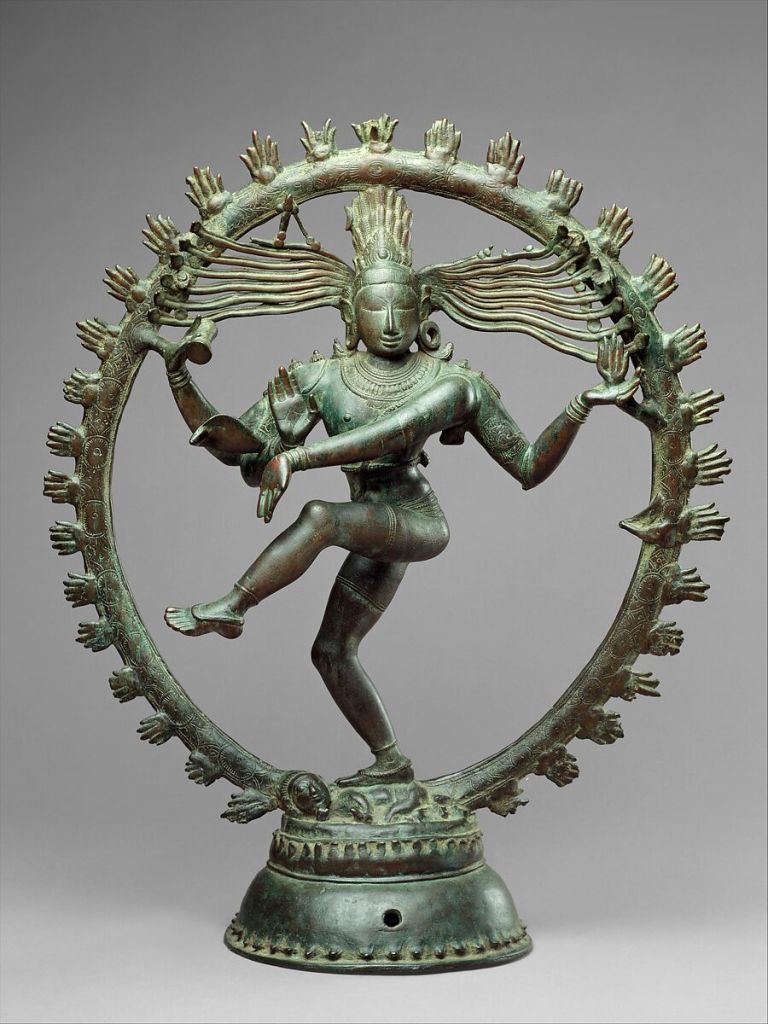
The answer is Shiva, the Hindu god and creator, preserver, and destroyer of the universe. He dances within a flaming halo. In one hand he holds the damaru (hand drum that made the first sounds of creation), and in another hand he holds agni (the fire that will destroy the universe). With a third hand he makes abhayamudra (the gesture that allays fear). As he dances he tramples on apasmara purusha (illusion, which leads mankind astray), while a fourth hand points to his raised left foot, signifying. refuge for the troubled soul.
She writes to him to praise him for having created a beautiful world but more to apologise for having nearly destroyed it. He is both creator and destroyer, and she writes to him more as destroyer. The time is coming both for her death (three years later) and for him to destroy the world. But for Shiva, if not for Raine, there is a cycle: a new world will come, which in its turn will be destroyed in preparation for yet another world.
As I approach my end, grateful for a rich life, I can imagine writing a poem (even worse of course) with similar sentiments.
Millennial Hymn to Lord Shiva by Kathleen Raine
Earth no longer
hymns the Creator,
the seven days of wonder,
the Garden is over —
all the stories are told,
the seven seals broken
all that begins
must have its ending,
our striving, desiring,
our living and dying,
for Time, the bringer
of abundant days
is Time the destroyer —
In the Iron Age
the Kali Yuga
To whom can we pray
at the end of an era
but the Lord Shiva,
the Liberator, the purifier?
Our forests are felled,
our mountains eroded,
the wild places
where the beautiful animals
found food and sanctuary
we have desolated,
a third of our seas,
a third of our rivers
we have polluted
and the sea-creatures dying.
Our civilization’s
blind progress
in wrong courses
through wrong choices
has brought us to nightmare
where what seems,
is, to the dreamer,
the collective mind
of the twentieth century —
this world of wonders
not divine creation
but a big bang
of blind chance,
purposeless accident,
mother earth’s children,
their living and loving,
their delight in being
not joy but chemistry,
stimulus, reflex,
valueless, meaningless,
while to our machines
we impute intelligence,
in computers and robots
we store information
and call it knowledge,
we seek guidance
by dialling numbers,
pressing buttons,
throwing switches,
in place of family
our companions are shadows,
cast on a screen,
bodiless voices, fleshless faces,
where was the Garden
a Disney-land
of virtual reality,
in place of angels
the human imagination
is peopled with foot-ballers
film-stars, media-men,
experts, know-all
television personalities,
animated puppets
with cartoon faces —
To whom can we pray
for release from illusion,
from the world-cave,
but Time the destroyer,
the liberator, the purifier?
The curse of Midas
has changed at a touch,
a golden handshake
earthly paradise
to lifeless matter,
where once was seed-time,
summer and winter,
food-chain, factory farming,
monocrops for supermarkets,
pesticides, weed-killers
birdless springs,
endangered species,
battery-hens, hormone injections,
artificial insemination,
implants, transplants, sterilization,
surrogate births, contraception,
cloning, genetic engineering, abortion,
and our days shall be short
in the land we have sown
with the Dragon’s teeth
where our armies arise
fully armed on our killing-fields
with land-mines and missiles,
tanks and artillery,
gas-masks and body-bags,
our air-craft rain down
fire and destruction,
our space-craft broadcast
lies and corruption,
our elected parliaments
parrot their rhetoric
of peace and democracy
while the truth we deny
returns in our dreams
of Armageddon,
the death-wish, the arms-trade,
hatred and slaughter
profitable employment
of our thriving cities,
the arms-race
to the end of the world
of our postmodern,
post-Christian,
post-human nations,
progress to the nihil
of our spent civilization.
But cause and effect,
just and inexorable
law of the universe
no fix of science,
nor amenable god
can save from ourselves
the selves we have become —
At the end of history
to whom can we pray
but to the destroyer,
the liberator, the purifier?
In the beginning
the stars sang together
the cosmic harmony,
but Time, imperceptible
taker-away
of all that has been,
all that will be,
our heart-beat your drum,
our dance of life
your dance of death
in the crematorium,
our high-rise dreams,
Valhalla, Utopia,
Xanadu, Shangri-la, world revolution
Time has taken, and soon will be gone
Cambridge, Princeton and M.I.T.,
Nalanda, Athens and Alexandria
all for the holocaust
of civilization —
To whom shall we pray
when our vision has faded
but the world-destroyer,
the liberator, the purifier?
But great is the realm
of the world-creator,
the world-sustainer
from whom we come,
in whom we move
and have our being,
about us, within us
the wonders of wisdom,
the trees and the fountains,
the stars and the mountains,
all the children of joy,
the loved and the known,
the unknowable mystery
to whom we return
through the world-destroyer, —
Holy, holy
at the end of the world
the purging fire
of the purifier, the liberator!


 A Cairn of Poems
Leave a reply to bobfeikema Cancel reply