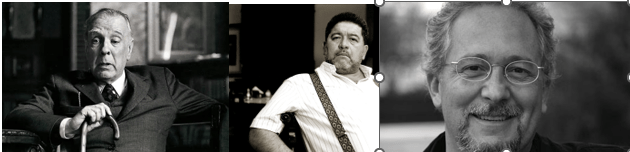
The sonnet that begins with the magnificent line “Already we are the oblivion that we shall be” was sent to me by a Colombian friend. The poem is said to have been found by Héctor Abad Faciolince, a friend of my friend, in the pocket of his dead father. Faciolince has written a long essay in Granta https://granta.com/the-poem-in-the-pocket/ in which he discusses whether the poem was written by Jean Luis Borges (1899-1986), Harold Alvarado Tenorio (1945–), or even Faciolince (1958–) himself.
After scanning (not fully reading) the essay I’m confused, which is, I think, the intention of the article. It’s magical realism. I picked out two sentences from the essay:
“The sonnet was beautiful, the sonnet was important to me, and that was enough.”
“I venture the hypothesis that the poems are by Borges even though Harold Alvarado wrote them . . .”
My Colombian friend shared the poem after me sending him a quote from Borges, a very marvellous quote;
“I am not sure that I exist, actually. I am all the writers that I have read, all the people I have met, all the women I have loved; all the cities I have visited.”
I shared that quote because my friend in his email had quoted that “vast, moth-eaten musical brocade” created to pretend we never die. I was surprised that a Colombian should quote Larkin, the English poet of despondency and decline, but then it seems that I introduced my friend to Larkin, which I had, of course, forgotten.
Anyway, the upshot is that I have this fine sonnet translated from Spanish—and we do know that Mathew Shorter translated the poem—and as a translation creates a new poem perhaps he is the true author.
I think it true that “Already we are the oblivion that we shall be,” but fear that many—and certainly not Donald J Trump—do not know it. It would be better if we all knew it. We would be more humble, ask less of the Earth that carries us for a our few moments. And our minds can be calmed by the thought of “those who will not know we lived on earth.” The thought overlaps with those in Thomas Gray’s Elegy Written in a Country Churchyard.
For who to dumb Forgetfulness a prey,
This pleasing anxious being e’er resign’d,
Left the warm precincts of the cheerful day,
Nor cast one longing, ling’ring look behind?
“Already we are the oblivion that we shall be” by Jean Luis Borges, Harold Alvarado Tenorio, Héctor Abad Faciolince, or Mathew Shorter
Already we are the oblivion that we shall be.
The elemental dust that does not know us
And that was red Adam and that now is
All men, and that we shall not ever see.
Already we are upon the grave both dates:
The beginning and the end. Obscene decay,
The casket and the shroud, the threnody,
The funeral oration and death’s rites.
I am not the fool who clings on hard
To the magic sound of his own name.
I think with hope of my forgotten fame,
Of those who will not know I lived on earth.
Here beneath the sky’s indifferent blue,
It calms my mind to think that this is true.
 A Cairn of Poems
Leave a comment