If you search the internet for a Shelley poem on the moon then you always find this poem:
To the Moon
I
Art thou pale for weariness
Of climbing heaven and gazing on the earth,
Wandering companionless
Among the stars that have a different birth, —
And ever changing, like a joyless eye
That finds no object worth its constancy?
II
Thou chosen sister of the Spirit,
That gazes on thee till in thee it pities …
In this poem the Moon is pale, weary, companionless, and to be pitied, but in another Shelley poem about the Moon, it is a lover, a crystal paramour, a most enamoured maiden, filled with the pleasure of love, and gazing on the object of its love from every side. The object of the moon’s love is the Earth.
I encountered this poem, which doesn’t seem to have a title, in The Age of Wonder: How the Romantic Generation Discovered the Beauty and Terror of Science by Richard Holmes, the biographer of Coleridge. The book celebrates an age of what Holmes calls romantic science, which began with the voyage of Joseph Banks to the South Seas in 1768-71 and ended with the death of Humphrey Davy in 1829. It was a time when science and the arts were not far apart, scientists wrote beautifully, and poets incorporated the wonders of science into their poems, and the public was excited by the discoveries of science.
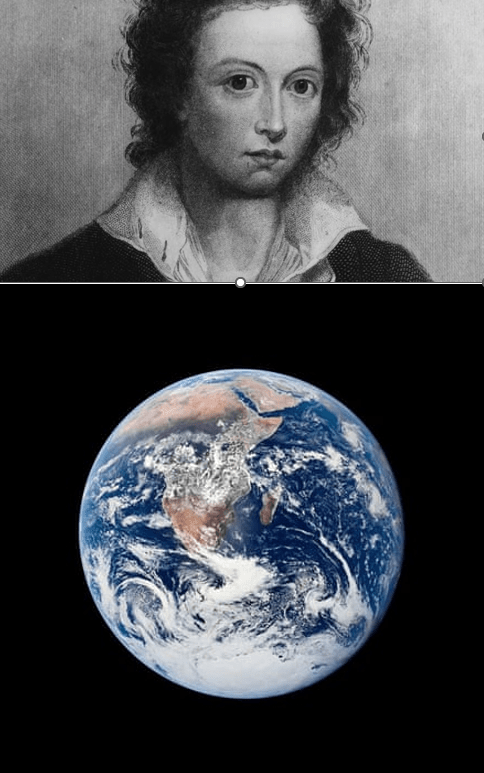
As Holmes points out, the first six lines of Shelley’s not-well-known poem evoke for modern readers the famous picture of the earth taken by astronauts to the moon:
Thou art speeding round the sun
Brightest world of many a one;
Green and azure sphere which shinest
With a light which is divinest
Among all the lamps of Heaven
To whom light and life is given…
The Moon’s love poem to the Earth
Thou art speeding round the sun
Brightest world of many a one;
Green and azure sphere which shinest
With a light which is divinest
Among all the lamps of Heaven
To whom light and life is given;
I, thy crystal paramour
Borne beside thee by a power
Like the polar Paradise,
Magnet-like of lovers’ eyes;
I, a most enamoured maiden
Whose weak brain is overladen
With the pleasure of her love,
Maniac-like around thee move
Gazing, an insensiate bride,
On thy form from every side…
Holmes, Richard. The Age of Wonder: How the Romantic Generation Discovered the Beauty and Terror of Science . HarperCollins Publishers. Kindle Edition.
 A Cairn of Poems
Leave a comment